Quick answer
What to do first
Check the cooler’s power and blue/red orientation first, then its exhaust and the room’s enclosure. If it runs continuously but cannot reach a freezing temperature, reduce incoming heat or add cooling capacity. A lower target alone does not make the cooler stronger.
Match your symptom
| Symptom | Likely cause | Check | Next action |
|---|---|---|---|
| No cooling at all | The machine is not operating | Select the cooler: check connection, breakdown and active events. | Restore power or repair the cooler; during a solar flare, protect food and wait for electrical equipment to work again. |
| It stays warm despite power | Wrong orientation or obstructed intake/exhaust | Blue should face the freezer; inspect both adjacent tiles for impassable construction. | Correct orientation when rebuilding and clear the obstruction. Do not demolish a working room before identifying the fault. |
| Exhaust space becomes very hot | Heat has nowhere to go | Inspect the red side and its roof. Is it a sealed hot closet? | Vent the hot side to an appropriate outdoor space rather than recycling its heat into the freezer. |
| Temperature resembles outdoors | The room is not properly enclosed | Inspect roof coverage, missing walls and doors held open. | Complete the enclosure and close unnecessary openings. |
| It freezes at night but warms by day | Cooling capacity cannot cover peak demand | Watch heat waves, frequent door use and continuous high-power operation. | Reduce traffic and heat leakage before adding another powered cooler. |
Follow the cooling fault tree
Start with the machine rather than the thermostat. No power means a power problem; an obstructed or reversed unit means a placement problem. Once both are ruled out, inspect where the hot side releases heat. Only then judge whether the room needs more cooling capacity.
For food storage, a modest target below freezing gives some margin for doors opening. Read the actual room temperature and the food’s storage state instead of treating the selected target as proof that the room has reached it.
Test one change at a time
Pause while inspecting, then resume to observe the result. Record which condition changed: an open door closed, the exhaust was opened to outdoors, or power returned. If the temperature begins moving toward the target, keep observing before spending materials on a larger redesign.
Use a short entrance route for hauling and eating rather than making the freezer a corridor. When testing peak demand, compare similar weather and door traffic; a cooler working during a mild night does not establish that it can handle a heat wave.
What not to change
Do not substitute a passive cooler for an electric freezer: it cannot reach freezing temperatures. Do not put the red and blue sides into the same sealed storage room and expect normal heat removal.
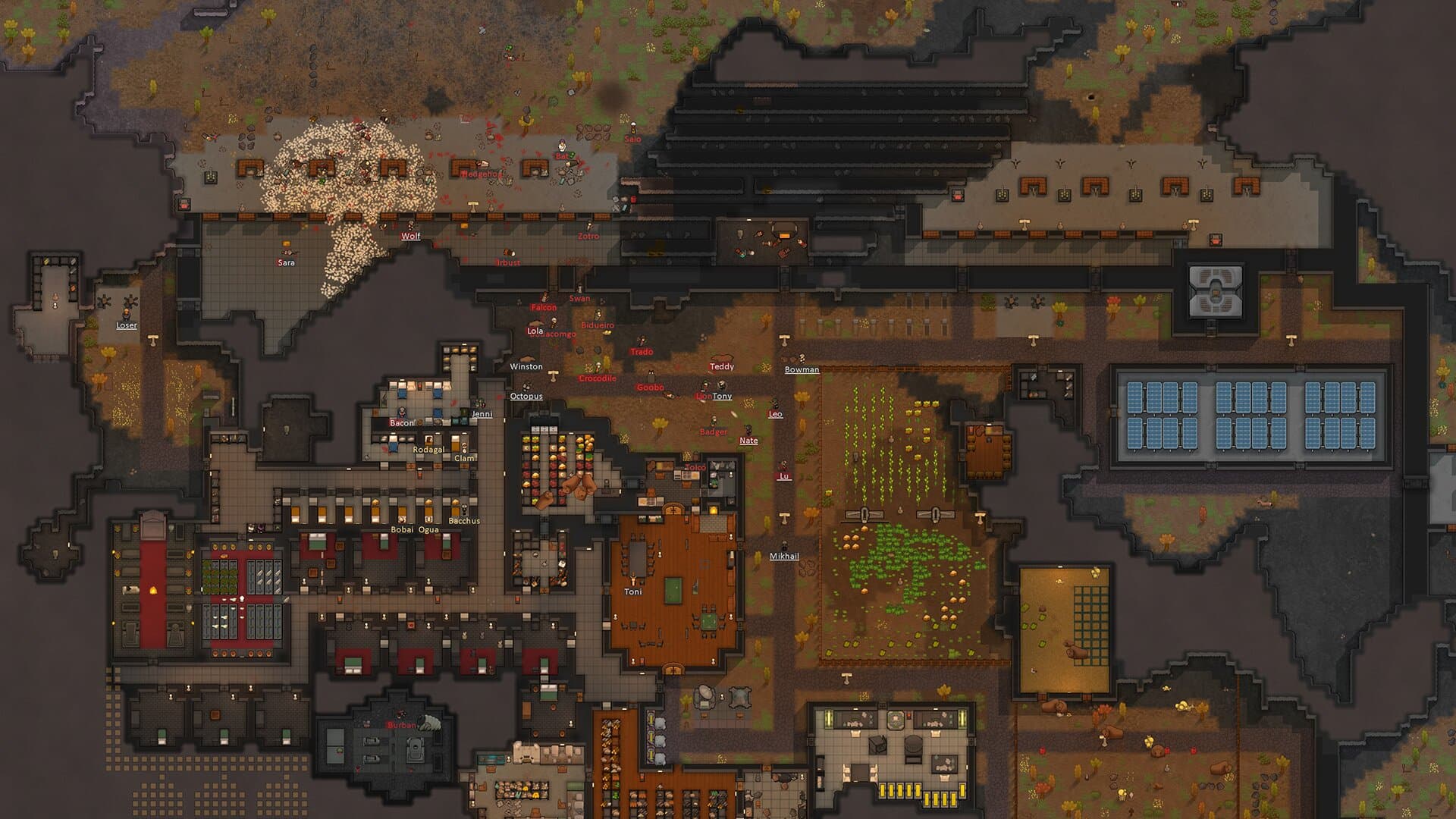
Avoid copying an exact cooler-per-room ratio from a screenshot. The official image is there to identify the game, not certify a layout. If the real problem is a colony-wide blackout, follow the power guide; if an Odyssey room lacks air, cooling alone will not fix pressure.
Version & sources
Sources & what may change
- Applies to
- Core · PC 1.6.4850. Ground-colony cooling; Odyssey pressure problems have a separate guide.
- Last verified
- 2026-09-04
- When to check again
- Recheck after a relevant game patch, DLC change or source correction. Mods can change these conditions.
Documentation reviewed; not an in-game test report. RimWorld Wiki is community-maintained, not Ludeon documentation.
Portions of the materials used to create this content/mod are trademarks and/or copyrighted works of Ludeon Studios Inc. All rights reserved by Ludeon. This content/mod is not official and is not endorsed by Ludeon.